vega-U: the universal checkpoint
vega-U decouples the decision engine from the LLM that reads for it. One 14.3M engine lives in a shared 1024-dimensional feature space, and every reader, from a 0.8B to a 27B, plugs into that space through a port: one small linear map per tapped layer. The engine bytes are identical behind every reader (the publish step asserts the checksum); only the port and the per-reader calibration differ. The reader is never fine-tuned, and the engine is never retrained to add one.
Loading
vega-U is the default model from vegaml 0.11. Changing the base model is naming it, nothing else:
import vegaml

v = vegaml.load()                                 # nandakishorm/vega-U, root reader (0.8B)
v = vegaml.load("4b")                             # the Qwen3.5-4B reader, same engine
v = vegaml.load("gemma-1b")                       # the Gemma 3 1B reader, same engine
v = vegaml.load(backbone="Qwen/Qwen3.5-4B")       # any reader, named by its own repo id
v = vegaml.load(backbone="google/gemma-3-1b-it")  # gated reader: set HF_TOKEN
v = vegaml.load("outputs/universal/per_backbone/Qwen3.5-4B")   # a training run's dir on disk
On a universal checkpoint, backbone= names WHICH reader. The last path component of the id
("gemma-3-1b-it") selects the directory inside the repo that carries that reader's port and
calibration; the reader's own weights still come from their original repository. Asking for
a reader the checkpoint ships no port for fails with the list of readers it does ship. On a
classic (non-universal) checkpoint, backbone= keeps its old meaning: an alternate location
of the same backbone.
Tokens belong to the reader, not to vega-U: Qwen readers load with no token, Gemma 3 is
gated, so HF_TOKEN must be set and the licence accepted on the Hub.
What a universal checkpoint contains
A vega-U directory is a classic vega model dir plus two files, named by two keys in
vega_config.json:
| file | config key | holds |
|---|---|---|
port.safetensors |
port |
this reader's linear maps into the shared space |
stats.npz |
raw_stats |
the reader's feature statistics from extraction |
At load time the runtime sees the port key, standardizes raw perception features with
stats.npz, maps them through the port, and runs the shared engine there. decide() and
everything downstream are identical to a classic checkpoint. In the Hub repository the root
is one reader (so the plain repo id loads with no subfolder) and every other reader is a
self-contained subfolder; universal/ carries the shared-space targets and ports the
training-side tooling uses, and the same recipe (a closed-form port fit, a short refine
against the frozen engine, a calibration refit) is what vegaml.attach runs locally, below.
Calibration never transfers between readers, so each directory ships its own.
Attaching your own reader
From 0.12, adding a reader is a package call, not a training run, and it needs none of the
original training data. The alignment is self-supervised: the checkpoint's root reader (the
anchor) computes the shared-space target for any text, so vegaml.attach fits the new port
from both readers reading the same prompts, on text you bring.
report = vegaml.attach("HuggingFaceTB/SmolLM2-1.7B-Instruct",
                       texts=my_texts, out_dir="vega-u-smollm2-1.7b")
v = vegaml.load("vega-u-smollm2-1.7b")
What runs: the anchor reads every text under six fixed probe questions (all three answer
types) and is freed; the new reader reads the same prompts; each tapped layer's map is fitted
in closed form (ridge, lambda by holdout cosine, option and memory-chunk rows folded into the
deepest layer) and then refined for a few hundred steps so the frozen engine decides the same
way through the new port as through the anchor, a plain distillation with the anchor MSE kept
on. The written directory carries the engine unchanged, byte for byte, plus
attach_ridge_cosines in its config so the fit quality travels with it.
A synthetic starter kit ships in the repo, regenerated by
examples/make_sample_attach_texts.py: examples/sample_attach_texts.txt (1,000
template-generated texts, one per line) for the attach itself, and
examples/sample_calibrate.json (the question sheet plus 600 labelled [state, labels]
examples with ground-truth labels) for the calibration that follows. Good for a first run;
your own domain text and labels are what a production port should be fitted on.
Requirements, honestly: at least 100 texts (1,000+ recommended, diverse beats big), GPU
memory for the new reader itself in bf16 (about 2 GB per billion parameters plus headroom;
CPU and MPS work, slower), and tens of minutes for a 7B reader over 1,000 short texts. The
dir is uncalibrated until vegaml.calibrate(out_dir, examples, questions) refits the
temperature, conformal, abstain and unbound thresholds on your labelled examples, roughly
500 per question type to be usable. A port fitted on your corpus is tuned to your domain;
the published numbers below describe only the ports we ship.
calibrate is not tied to attach. Passed a loaded shipped reader,
vegaml.calibrate(vegaml.load(), examples, questions) refits that reader's calibration on
your own outcomes, applied in place and written into your local copy of the checkpoint (a
cache snapshot's config symlink is replaced by a real file, so the blob store stays intact
and the Hub copy is never touched).
Measured, October 2026
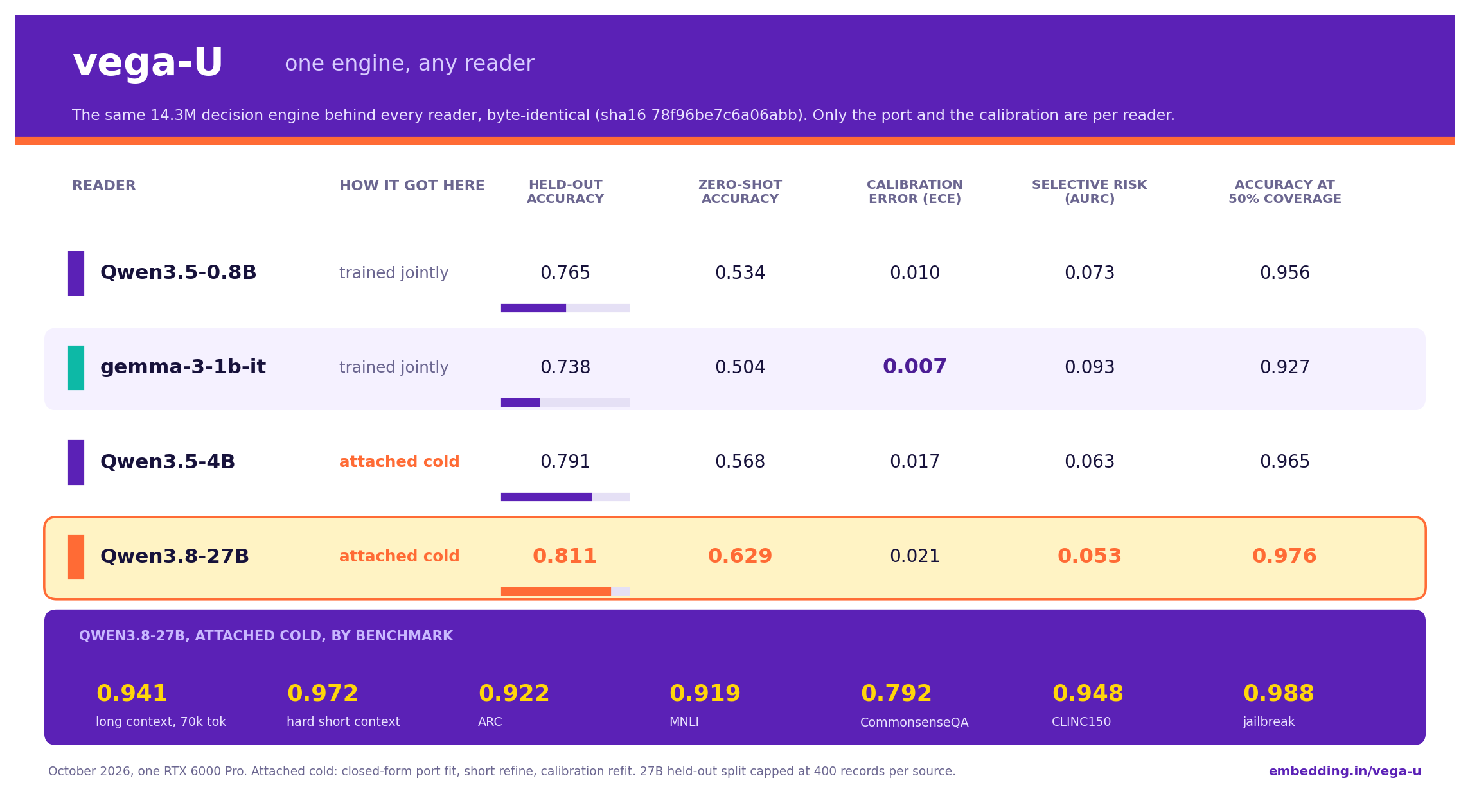
Trained jointly on Qwen3.5-0.8B and Gemma 3 1B (708,657 uid-matched items, records up to 73,728 tokens, a cross-reader invariance loss pulling the same item's ported features together across tokenizers). The 4B and the 27B were attached cold afterwards, and every cold-attached reader scored above the readers the engine trained with:
| reader | how | held-out acc | zero-shot acc | ECE | AURC | acc @ 50% cov |
|---|---|---|---|---|---|---|
| Qwen3.8-27B | attached cold | 0.811 | 0.629 | 0.021 | 0.053 | 0.976 |
| Qwen3.5-4B | attached cold | 0.791 | 0.568 | 0.017 | 0.063 | 0.965 |
| Qwen3.5-0.8B | trained jointly | 0.765 | 0.534 | 0.010 | 0.073 | 0.956 |
| gemma-3-1b-it | trained jointly | 0.738 | 0.504 | 0.007 | 0.093 | 0.927 |
The gains land where reading matters and nowhere else, which is exactly the design's claim.
Per source, 0.8B against 27B: long context to 70k tokens 0.831 to 0.941, hard short context
0.875 to 0.972, ARC 0.647 to 0.922, CommonsenseQA 0.490 to 0.792, OpenBookQA 0.602 to 0.838,
ANLI 0.561 to 0.776, MNLI 0.836 to 0.919. Saturated perception tasks stay flat across all
four readers (Bitext intents 0.99, Enron-Spam 0.99, phishing 0.99, AG News 0.92 to 0.93),
and the ordinal score question type sits near 0.61 for every reader: that ceiling belongs
to the engine or the labels, not the reader.
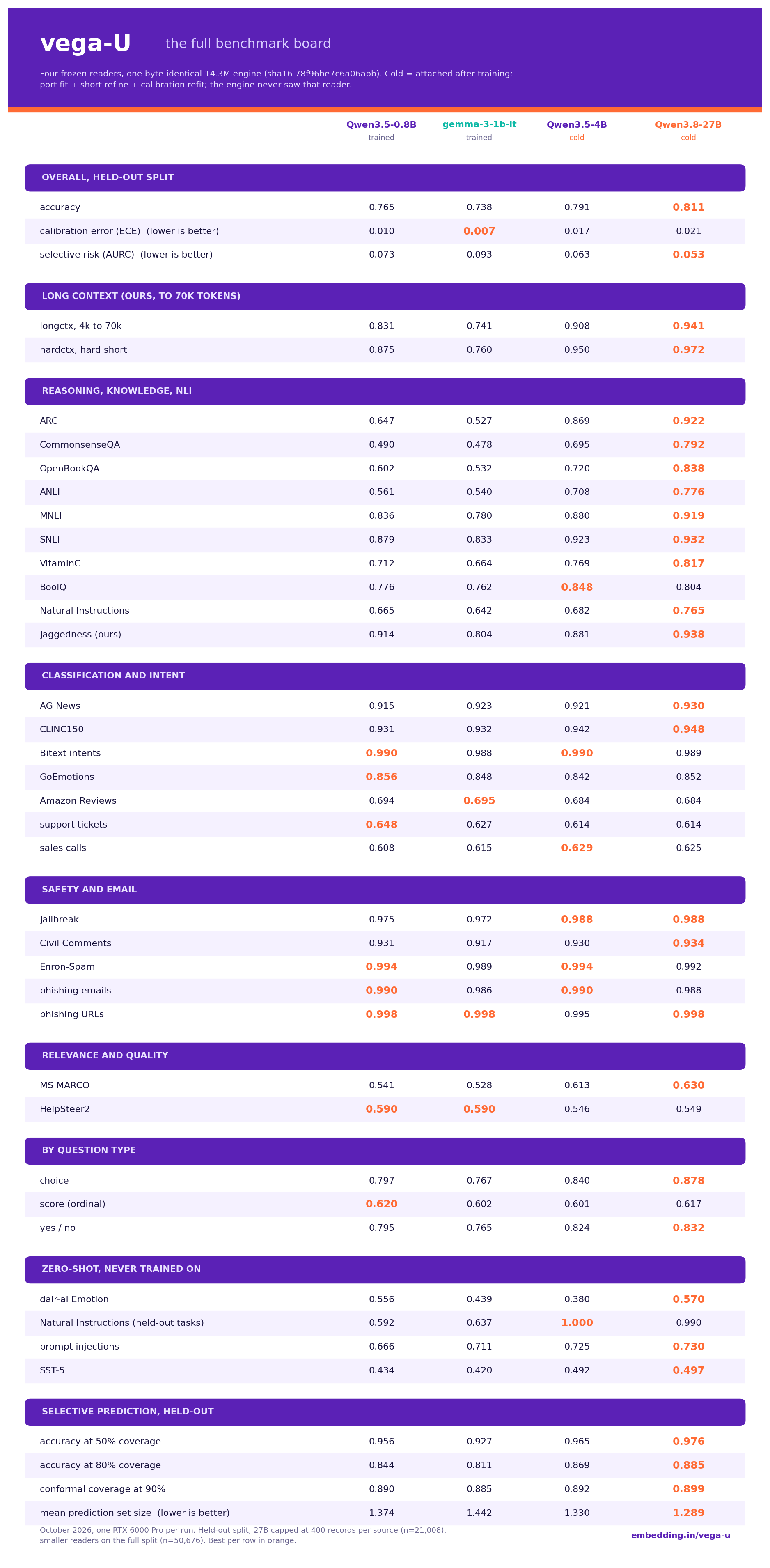
Caveats that belong next to the numbers: the 27B's held-out split is capped at 400 records
per source (n=21,008) while the smaller readers are scored on the full split (n=50,676), and
each run's raw per-source detail ships as eval_report.json in its reader directory.
What changed, by version
- 0.10.0: universal checkpoints load.
Vegarecognises theportkey, wraps the engine in the standardize-then-port step, and the Hub allow-list gainsport.safetensorsandstats.npz(the npz is read withallow_pickle=False, pinned by a test). - 0.10.1:
backbone=names the reader. The matching directory is selected by name, its subfolder is fetched under the same data-only allow-list, and a missing port fails with the list of readers the checkpoint ships. - 0.11.0: vega-U becomes the default.
load()with no argument is the universal 0.8B;"4b"and"gemma-1b"pick other readers of the same engine. The earlier per-size checkpoints stay loadable by their full repository id. - 0.12.0: attach your own reader.
vegaml.attach(backbone, texts, out_dir)fits a port locally and self-supervised (the anchor generates the targets), andvegaml.calibraterefits calibration on your own labelled examples. Also fixes default loading: a universal config stores the bare reader name ("Qwen3.5-0.8B"), which is now resolved to the real Hub id before the reader downloads. - 0.12.1:
vegaml.calibrateon a Hub-loaded model writes safely. A cache snapshot'svega_config.jsonis a symlink into the blob store; the refit now replaces the link with a real file instead of writing through it, so the content-addressed blob keeps its bytes and the refit persists for laterload()calls on the same machine. - 0.12.4:
vegaml.calibratestays a function. The package also ships a legacyvegaml/calibrate.pymodule, and the first import of a submodule binds it onto the package over whatever held the name; 0.12.3's fit started importingevals, which imports that module, so onefit()call turnedvegaml.calibrateinto a module and the next calibrate call died with "'module' object is not callable". The package now spends that one binding at import time and gives the name back to the function. - 0.12.3: three contributed fixes.
mode="auto"now switches to a fitted head only when its cross-validated accuracy beats the engine's own accuracy on the same examples, not just chance, so a thin head can no longer displace a strong calibrated engine (the head stays available to a deliberatemode="ttt"). The package reads its own UTF-8 files as UTF-8 rather than the locale encoding, fixing startup on non-UTF-8 Windows locales. And a secondattachinto the sameout_dirno longer dies on the read-only engine copy the first run inherited from the HF cache. - 0.12.2: an attached dir loads by its reader's full repository id.
attachstores the id it was given ("HuggingFaceTB/SmolLM2-1.7B-Instruct") in the config'sbackbonekey, and the loader now uses it when it is shaped like a repository id; before, it fell through to the barebackbone_name, which drops the namespace and 401s for any reader outside the shipped ones. Dirs attached under 0.12.0 and 0.12.1 load correctly with no re-attach.