How it works
One prompt, one forward pass, then physics. No text is generated anywhere in the path.
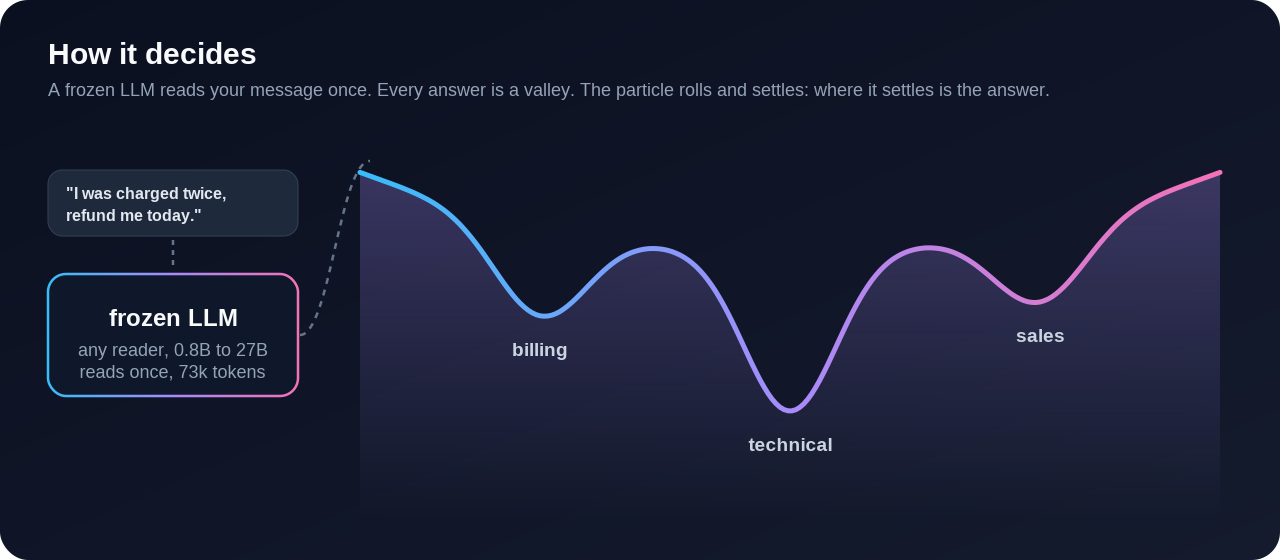
The six steps
1. One formatted prompt. The state, the question and every candidate answer are written into a single sequence:
Observation: {state} Measurement ({type}): {instructions} Possible outcomes: * {option 1} * {option 2} Outcome:
The option text is part of the model's input, not metadata kept outside it. There is no system prompt, no chat template and no demonstrations.
2. One forward pass. The frozen language model (the reader) runs once over that sequence. vega pools different token spans from the same hidden states: the situation, the question, one span per answer option, and the final token.
3. The input becomes a particle. The situation vector, the question and the final token place a particle at a position with a momentum in a 64-dimensional decision space.
4. Every candidate answer becomes a valley. Each option's own features produce a well with a centre, a depth and a width:
The quadratic term keeps the particle bounded and each well pulls it toward one answer. Score levels sit on a one-dimensional rail, so neighbouring scores are physical neighbours.
5. The particle rolls and settles. Damped Hamiltonian dynamics for a fixed, small number of steps, with early exit once it has settled. A decision is a short simulation with constant cost, not a sampling loop, so it is deterministic.
6. Where it settles is the answer.
Abstain and unbound
abstain: the engine declines to commit. Its threshold is calibrated so that, among the answers it does give, the error rate stays under the configured risk (10% by default).prediction_set: the conformal set, every option the answer could still be atalpha0.10. One option means it is sure; two or more means the input really is ambiguous.unbound: the particle settled far from every well, so the input looks unlike anything the engine knows. It is reported on every answer, but on its own it is a weak signal: measured, it also fired on 71% of normal banking77 rows. Route onabstainand the set, or on a fitted band.
One engine, any reader
The engine lives in a shared 1024-dimensional space that no single language model owns. A reader
connects to it through a small linear port, so the same 14.3M engine, byte for byte, works behind
readers from 0.8B to 27B, and vegaml.attach() connects your own. See vega-U.
Two ways to answer
- The engine answers any question zero-shot, including options it has never seen, with the calibrated probability and the flags above.
- A head fitted on your labelled examples is sharper where your labels match the examples,
and has no abstain flag.
mode="auto"uses a head only where it beats the engine on the same rows.
Continuous learning builds on the second: heads that are refitted as your team confirms answers, with the engine answering until a head has earned its place.
The paper
M, N.; M, A. From Laya to Vega: Open Non-Autoregressive Decision Models with Calibrated Probabilities. Preprints 2026, 2026110781. doi:10.20944/preprints202611.0781.v1